



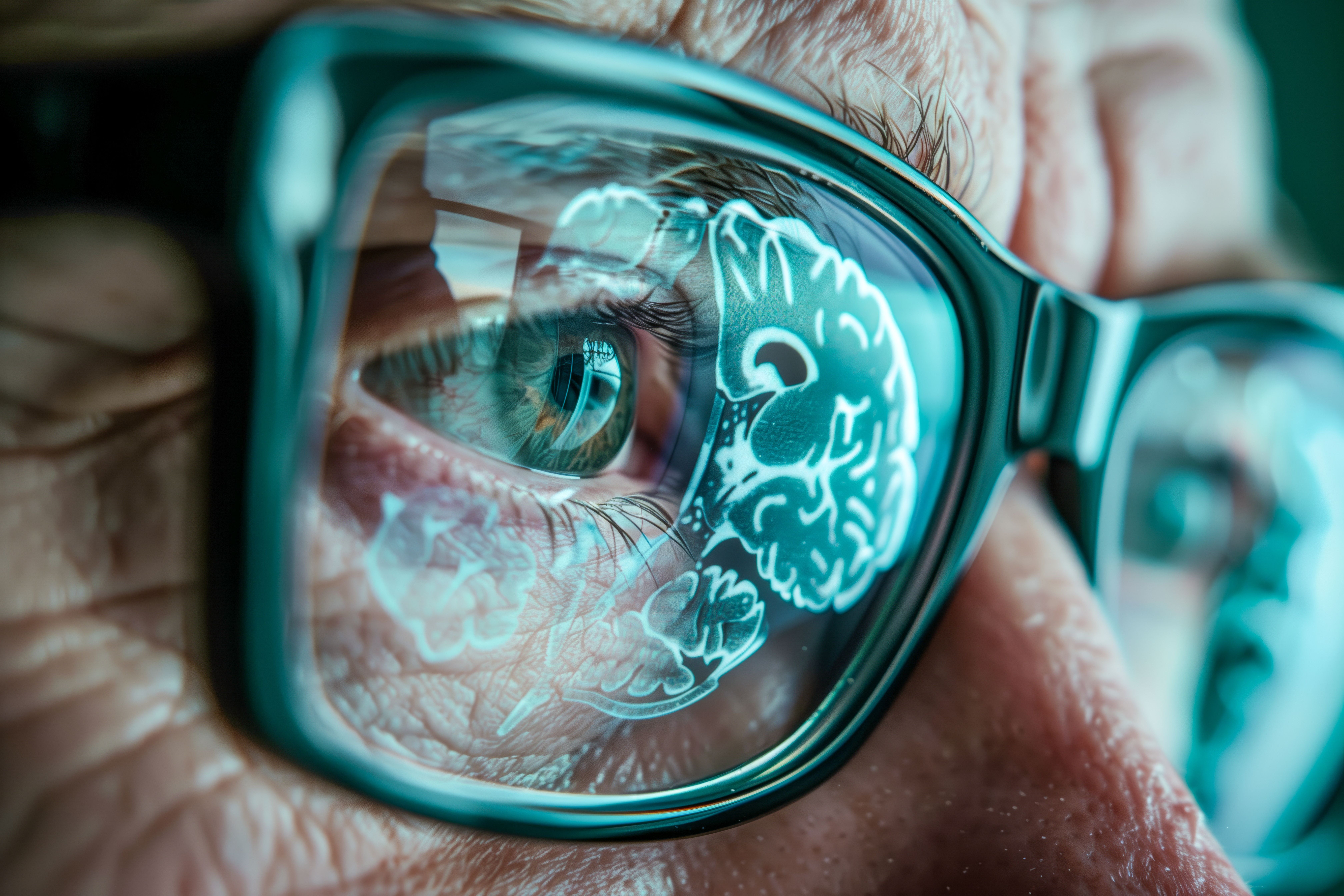
We tend to take the act of seeing for granted. We open our eyes and the world is simply “there”, sharp and full of colour 🎨. Instinctively, we give all the credit to our eyes. But what if we told you that what really “sees” is not your eyes, but your brain?
Imagine that your eyes are the most sophisticated cameras in the world 📸, capable of capturing light and colour with astonishing precision. However, a camera only captures data. It is a supercomputer, our brain, that processes, interprets and transforms that data into the rich, three-dimensional film we call “vision” 🎬. At Clínica Ramírez & Gálvez, we invite you on a journey to discover this incredible partnership.
The Eye: The High-Tech Camera 📸
The way the eye works is a marvel of biological engineering. Put very simply, it works like this:
- Light passes through the cornea and the lens, which focus it.
- The iris (the coloured part) adjusts to regulate how much light enters.
- The light reaches the retina at the back of the eye. Here, millions of photoreceptor cells (cones and rods) convert that light into electrical impulses.
But here comes the surprising part: the image projected onto the retina is actually small, two-dimensional and upside down! 🙃 On its own, our eye sends a “raw” signal to the brain.
The Brain: The Supercomputer That Creates Reality 💻✨
This is where the real magic happens. Those electrical impulses travel along the optic nerve to the brain’s visual cortex 🧠, which carries out spectacular post-production work in real time:
- It turns the image the right way up: The first thing it does is rotate the image so that we perceive the world in its correct orientation.
- It creates 3D vision (stereopsis): The brain receives two slightly different images (one from each eye) and merges them into one, creating the perception of depth and volume. This is what allows us to tell whether something is near or far.
- It fills in the gaps: We all have a “blind spot” in each eye, an area of the retina with no photoreceptors where the optic nerve connects. Why don’t we see a black hole? Because the brain “invents” the missing information based on the surroundings, and we don’t even notice.
- It interprets and gives meaning: The brain does not just see shapes and colours; it compares them with our memory and experiences to tell us what they are: a familiar face, a road sign, a written word.
When the Connection Fails: The Case of “Lazy Eye” 🔌❌
The perfect example of this eye–brain connection is amblyopia, or “lazy eye”. In many cases, the “lazy” eye is anatomically perfect. The problem is that, during childhood, the brain learnt to ignore the signal from that eye (perhaps because of a squint or a large difference in prescription between the eyes).
Treatment, such as wearing a patch over the healthy eye, does not “cure” the lazy eye; instead, it forces the brain to “reconnect” with it and learn to process its signal. This shows that seeing well depends not only on having healthy eyes, but also on perfect communication with the brain.
Caring for Your Vision Means Caring for a Whole System ❤️
Vision is one of the most complex and wonderful processes in our body. It is not an isolated act of the eyes, but a perfect collaboration 🤝 with our brain.
That is why, in a complete eye examination, we not only assess the health of the “camera” (your prescription, eye pressure and the condition of the retina), but also make sure the whole visual system is working in harmony ✨. Because caring for your vision means caring for that incredible window through which your brain interprets the world.