


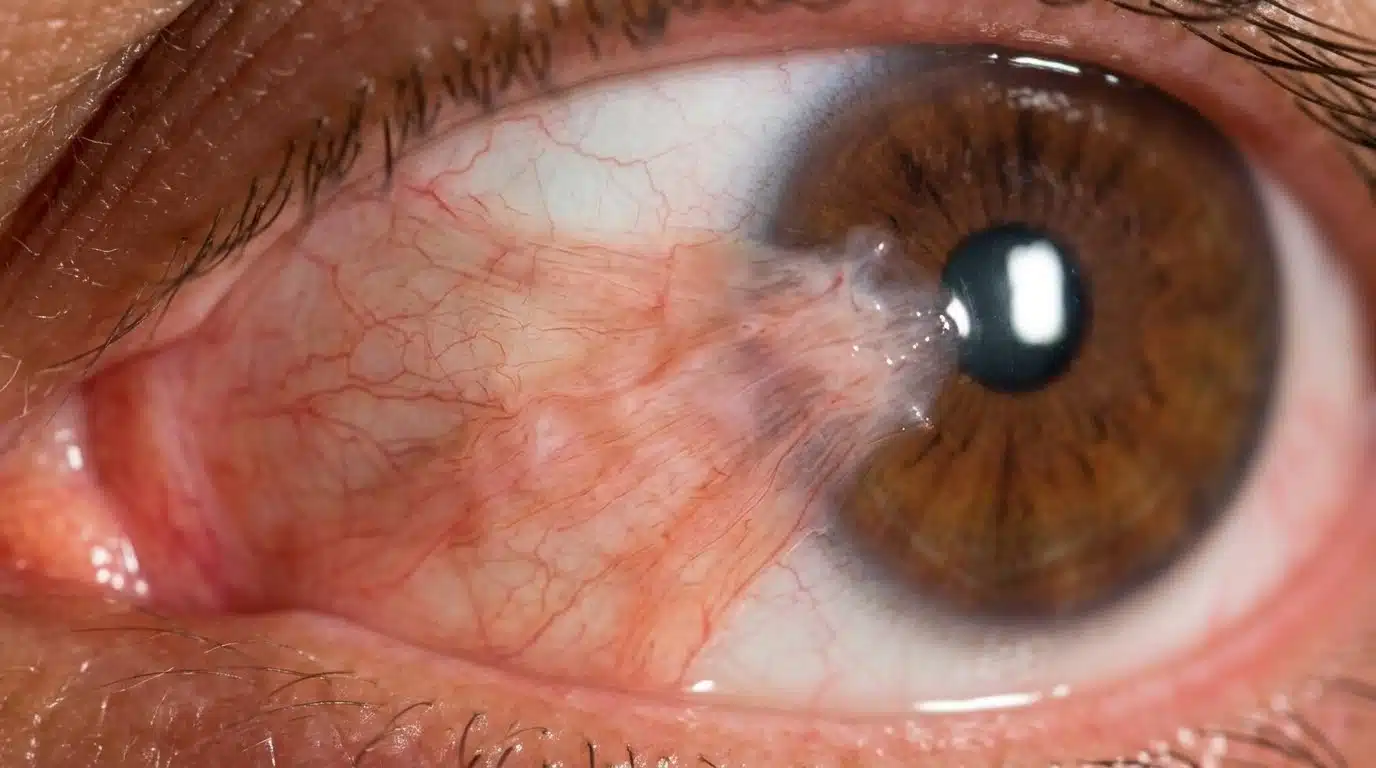
In sunny, coastal regions like ours (especially in exposed areas such as Torre del Mar or inland in the province of Córdoba), it is very common to see adults develop a small lump or whitish, fleshy tissue on the white surface of the eye (the sclera) that gradually advances towards the cornea.
This mucocutaneous lesion is technically known as a pterygium and is popularly called “surfer’s eye”. Although in its early stages it is usually considered merely a cosmetic nuisance or a minor irritation, if the pterygium keeps growing it can distort the cornea and significantly affect your vision. At Clínica Ramírez & Gálvez, we explain what causes this condition and how modern autograft surgery removes it cleanly and durably, with minimal risk of recurrence.
Why does a pterygium appear? The environmental factors 🧐
A pterygium is not a malignant tumour or a dangerous cyst, but an abnormal, inflammatory growth of the conjunctiva (the transparent membrane covering the eye) that invades the cornea (the transparent “window” at the front of the eye).
The main cause of its development is continued, unprotected exposure to environmental factors that are harsh on the ocular surface:
- Ultraviolet (UV) radiation: The sun is the number one trigger. UV radiation damages the stem cells in the corneal limbus, disrupting tissue repair and stimulating the invasive growth of the conjunctiva.
- Wind and dryness: Constant wind speeds up the evaporation of the tear film, keeping the eye in a state of chronic inflammation.
- Dust, sand and salt spray: Elements that are very common on beaches or in outdoor work and irritate the ocular surface day after day.
For this reason, it is particularly common among farmers, outdoor sportspeople, sailors and people who spend a lot of time exposed to the midday sun.
Common symptoms: from irritation to blurred vision 💡
A pterygium usually forms on the side of the eye closest to the nose and slowly advances towards the centre of the pupil. As it progresses, it produces very distinct symptoms:
- Red, inflamed eye: The tissue contains numerous dilated blood vessels, making the eye look irritated and congested.
- Foreign body sensation: A constant feeling of grit, rubbing or something foreign inside the eye.
- Stinging and watery eyes: Recurring discomfort made worse by heat, air conditioning or reading.
- Induced astigmatism: As it grows over the cornea, the pterygium “pulls” on it and distorts its natural curvature, causing blurred vision or progressive astigmatism.
- Direct loss of vision: In very advanced cases where the tissue covers the pupil (the central visual axis), it causes a severe loss of visual acuity.
Treatment: from eye drops to autograft surgery 🔬
When the pterygium is small and only causes mild discomfort, medical treatment consists of preservative-free artificial tears and anti-inflammatory eye drops prescribed by the ophthalmologist to reduce irritation.
However, eye drops do not make the tissue disappear. When the pterygium grows, causes astigmatism, leads to frequent inflammatory flare-ups or is cosmetically unsatisfactory, the only definitive treatment is surgery.
The key to success: pterygium surgery with conjunctival autograft
In the past, surgery was limited to “scraping” or excising the pterygium and leaving the area bare. That technique had an extremely high recurrence rate (in up to 50% of cases the tissue grew back more aggressively).
Today, at Clínica Ramírez & Gálvez we use the advanced technique of excision with conjunctival autograft:
- Clean resection: All the fibrovascular tissue of the pterygium is carefully removed and the cornea is polished.
- Healthy autograft: A small piece of healthy conjunctiva is taken from the patient’s own eye (usually from the upper area, hidden by the eyelid), which contains healthy stem cells.
- Sealing with tissue adhesive: We place the graft over the bare area. To avoid uncomfortable stitches, we use biological glues (fibrin adhesives) that secure the graft in seconds, speed up healing, reduce post-operative discomfort to almost zero and lower the recurrence rate to less than 2–3%.
Prevention and care in Lucena and Torre del Mar 🏥
Prevention remains the best tool against pterygium. Wearing certified UV400 sunglasses with side protection, together with good tear hydration, is essential to prevent it from appearing or to slow its growth if it has already started to form.
At both our Lucena and Torre del Mar clinics, our team of ophthalmic surgeons assesses how your pterygium is progressing using corneal topography and biomicroscopy, to determine whether it needs conservative treatment or whether the time is right for a clean, definitive surgical solution.
Looking after the health and appearance of your eyes’ surface is the best way to keep your eyes healthy, white and comfortable.
Have you noticed a small fleshy lump on your eye, a constantly red eye or a gritty feeling?
Don’t wait until it affects your vision! Book your check-up at our clinics in Lucena or Torre del Mar and restore comfort to your eyes. 📅✨