



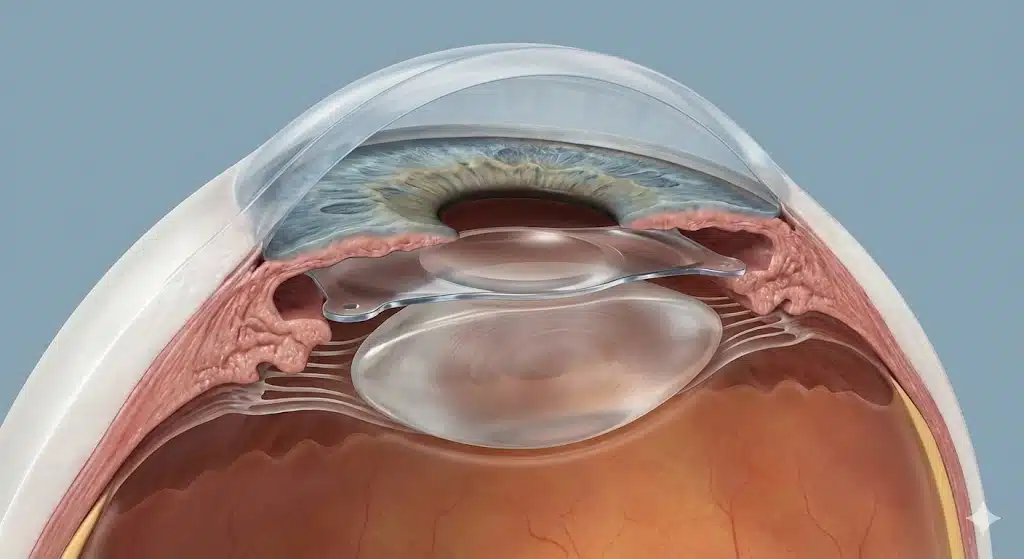
ICL surgery (Implantable Collamer Lens) has become the preferred technical alternative for patients who want complete visual freedom but are not suitable candidates for laser procedures. At Clínica Ramírez & Gálvez, guided by the surgical judgement of Dr. Javier Ramírez and Dr Sonia Gálvez, we use this refractive approach to treat myopia, hyperopia and astigmatism in cases where preserving the architecture of the cornea is the absolute priority.
🔬 What is an ICL lens and why does its biocompatibility stand out?
Unlike techniques that reshape the corneal tissue through ablation, the ICL is a phakic lens placed inside the eye, specifically in the posterior chamber (between the iris and the natural lens).
It is made of Collamer, an exclusive high-tech material that combines collagen with state-of-the-art polymers. This composition offers decisive clinical advantages:
- Total biocompatibility: Because it contains natural collagen, the eye does not perceive it as a foreign body, eliminating the risk of rejection or chronic inflammation.
- Built-in UV protection: The material has an active filter that protects the internal structures of the eye from ultraviolet radiation.
- Superior optical quality: As it does not alter the shape of the cornea, the visual sharpness and contrast sensitivity achieved are often better than those obtained with glasses or contact lenses.
🎯 Technical indications: when is it the option of choice?
At our clinics in Lucena and Torre del Mar, we recommend phakic lens implantation after a thorough study of the anterior chamber and the endothelial cell density. It is the reference technique in the following scenarios:
- High prescriptions: Patients whose dioptres exceed the safety limits of laser surgery.
- Thin or irregular corneas: As an additive procedure, it does not weaken the corneal structure, making it ideal for patients with limited corneal thickness.
- Dry eye: Because it does not cut the nerve plexuses of the ocular surface, it is the surgery that best respects the tear film.
🏥 Surgical rigour: a reversible procedure
The procedure is performed under high-resolution microscopy, allowing atraumatic insertion through a tiny micro-incision.
- Minimally invasive: The lens unfolds gently into its final position, allowing almost instant visual recovery.
- Reversibility: Unlike laser surgery, this procedure is fully reversible. The lens can be removed or replaced in the future if the patient’s anatomy or visual needs change (for example, if cataracts develop).
Combining cutting-edge technology with the experience of Dr. Javier Ramírez and Dr Sonia Gálvez allows us to approach every case with mathematical precision, guaranteeing the clinical safety that our patients and professional colleagues expect from us.
Understanding whether your eye anatomy is suitable is the first step towards a life without visual limits. Book your appointment for a personalised assessment.