


Lazy Eye or Amblyopia
Lazy eye, or amblyopia, is a childhood vision problem in which one eye does not develop normal visual acuity because it has not received adequate stimulation.
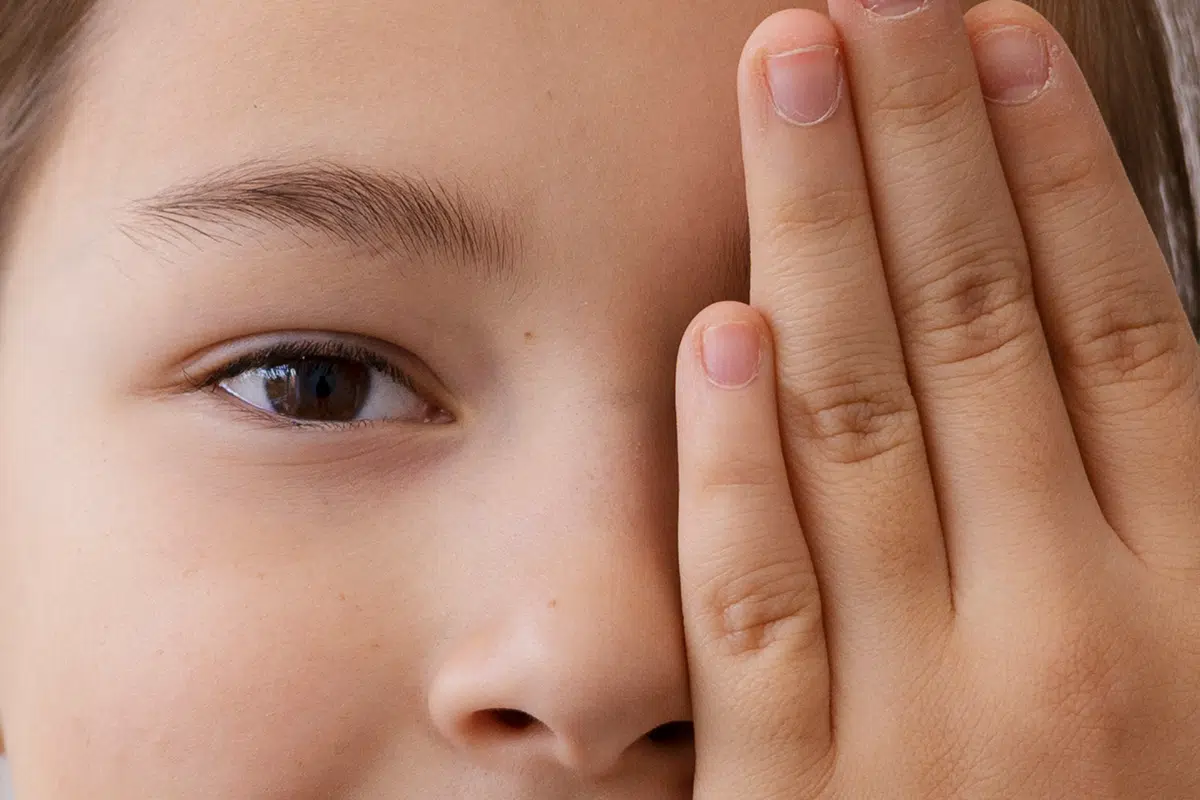
It is the leading cause of vision loss in childhood, affecting between 2% and 5% of children worldwide.
It should be treated as early as possible, ideally before the age of 6, to achieve the best visual recovery.
It can affect school performance and sporting activities. Early diagnosis is key.


What is lazy eye or amblyopia?
A lazy eye develops when the connection between the eye and the brain does not form properly, so that one eye sees less well than the other. In most cases, the brain favours the dominant eye and the other becomes "lazy".
This problem can easily go unnoticed, as children do not usually notice the difference in their vision. That is why eye examinations are essential to detect it in time.
How can you tell if your child has amblyopia?
✅ One eye turns (strabismus).
✅ Difficulty focusing or seeing at distance or close up.
✅ Tilting the head or closing one eye when looking at something.
✅ Poor coordination or clumsiness when playing or picking up objects.
✅ Frequent headaches or eye strain.
✅ Lack of visual response in one eye.
✅ Not noticing that one eye sees less well (the child does not complain because the other eye compensates).
If you suspect that your child may have amblyopia, it is advisable to arrange an eye examination as soon as possible.
Factors that can cause amblyopia in children:
🔹 Strabismus (strabismic amblyopia): This is the most common cause. When one eye turns, the brain ignores the image from that eye to avoid double vision.
🔹 Refractive errors (refractive amblyopia): Uncorrected myopia, hyperopia or astigmatism can make one eye see worse than the other.
🔹 Difference in prescription between the two eyes (anisometropic amblyopia): If one eye has much higher myopia, hyperopia or astigmatism than the other, the brain favours the eye with better vision and suppresses the image from the other. The eye with the weaker prescription is not used properly and becomes amblyopic.
🔹 Deprivation amblyopia. This occurs when something blocks the vision of one eye during the first years of life, preventing it from developing. It can be caused by:
- Congenital cataract (clouding of the lens).
- Eyelid ptosis (a drooping eyelid that covers the eye).
- Corneal scarring or retinal problems.
🔹Risk factors:
- A family history of amblyopia increases the risk of a child developing it.
- Premature birth or low birth weight.
Options to restore vision and stimulate the affected eye
🔹 Glasses or contact lenses: These are used to correct refractive problems such as myopia, hyperopia or astigmatism. In some cases, glasses alone are enough to improve vision without the need for other treatments.
🔹 Patching the dominant eye (occlusion): A patch is placed over the healthy eye to make the lazy eye work and strengthen its connection with the brain.
🔹 Atropine in the healthy eye: Drops that temporarily blur the vision of the dominant eye to encourage use of the lazy eye. It is an alternative to patching, especially for children who do not tolerate occlusion well.
🔹 Vision therapy: Specific exercises to stimulate the vision of the affected eye.
🔹 Surgery (in specific cases): Recommended if the amblyopia is caused by severe strabismus, congenital cataracts or eyelid ptosis. Surgery corrects the underlying cause, but visual rehabilitation is still needed afterwards.
The success of treatment depends on the child's age and on how consistently it is followed.
Our Clinic
Unique spaces designed with one philosophy: excellence in caring for your eyes.




Detailed Diagnosis
A trusted environment where we listen to you, carry out a detailed diagnosis and design a personalised treatment plan together.




Commitment to Excellence
A team of professionals led by Drs. Ramírez and Gálvez with a dual commitment: medical excellence and close, human care.


Cutting-Edge Technology
Equipped with the latest technology to ensure diagnoses of maximum precision and to plan every treatment with complete safety.
Answers to your questions
We answer the most common questions about lazy eye or amblyopia in children. Here you will find all the information you need to look after your child's vision with confidence.
At what age can lazy eye be detected?
It can be diagnosed from the first months of life, but it becomes more evident from the age of 2–4.
Can lazy eye be corrected in adults?
Treatment is most effective in childhood, as visual development is complete at around the age of 8–10. In adults, the improvement is more limited.
How long does lazy eye treatment last?
It depends on the severity of the case, but it usually requires months or even years of treatment and follow-up.
Do eye patches really work?
Yes, it is one of the most effective ways of treating amblyopia in children when used consistently and under medical supervision.
Is lazy eye always associated with strabismus?
No, some children with amblyopia have aligned eyes, but one sees worse due to an uncorrected refractive problem.
How can amblyopia be prevented in children?
Regular eye examinations help to detect and treat any vision problem in time.