


Congenital Glaucoma
Congenital glaucoma is an eye disease that is present from birth or appears in the first years of life and is characterised by an abnormal rise in intraocular pressure.
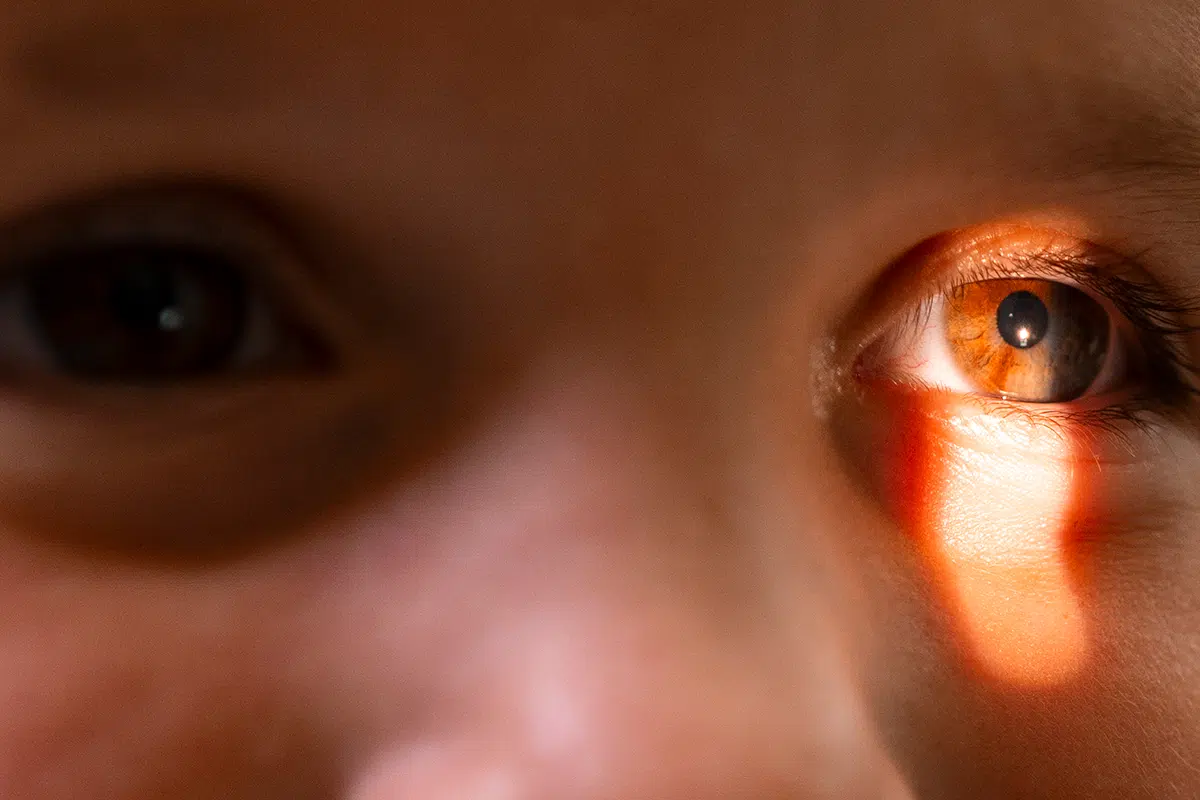
It affects approximately 1 in every 10,000 births.
80% of cases are diagnosed before the first year of life.
Surgical treatment has a high success rate when performed in time.


What is congenital glaucoma?
An eye problem that can compromise a baby's vision.
Congenital glaucoma occurs when there is a defect in the development of the eye's drainage system, which prevents the aqueous humour from draining properly and causes intraocular pressure to rise. This raised pressure progressively damages the optic nerve and can affect the child's sight.
Although it is a rare disease, early detection is key to preventing irreversible damage to vision.
Signs that may point to this disease in babies and children
✅ Large eyes (buphthalmos): Raised intraocular pressure can make a baby's eyes look larger than normal.
✅ Excessive tearing: One of the most common symptoms in babies with glaucoma.
✅ Sensitivity to light (photophobia): The child may avoid light or keep their eyes closed.
✅ Corneal clouding: The cornea may become greyish or cloudy.
✅ Frequent blinking: This can be a response to the discomfort caused by eye pressure.
✅ Eye irritation and redness: It can be mistaken for conjunctivitis, but it persists over time.
If you notice any of these symptoms in your child, it is essential to see a paediatric ophthalmologist as soon as possible for a detailed assessment.
Why does this disease occur in babies?
🔹 Malformation of the eye's drainage system: Abnormal development of the iridocorneal angle prevents the aqueous humour from draining.
🔹 Genetic factors: It can be hereditary in 10–40% of cases, with mutations in certain genes.
🔹 Associated congenital syndromes: Some disorders such as Sturge-Weber syndrome, Axenfeld-Rieger syndrome and neurofibromatosis type 1 can include glaucoma among their features.
🔹 Intrauterine infections: Infections during pregnancy, such as congenital rubella, can affect the development of the baby's eyes.
Early diagnosis allows appropriate treatment and better long-term visual results.
Medical and surgical options to control the disease
🔹 Eye drops and medication: These are used to lower intraocular pressure, although in most cases they are not enough on their own.
🔹 Glaucoma surgery (main option): Surgery is the most effective treatment to improve drainage of the aqueous humour and lower eye pressure. There are different surgical techniques, such as:
🔹 Goniotomy (if the cornea is clear): An incision is made in the trabecular meshwork to open the eye's drainage system. It gives good results if the condition is detected in time.
🔹 Trabeculotomy: This is performed when the cornea is not clear enough for a goniotomy.
🔹 Trabeculectomy. This is useful in more advanced cases or when other operations have not been effective.
🔹 Drainage implants: In more severe cases, devices (such as the Ahmed valve) are fitted to regulate the outflow of aqueous humour.
The success of treatment depends on strict ophthalmological follow-up and early detection of the problem.
Our Clinic
Unique spaces designed with one philosophy: excellence in caring for your eyes.




Detailed Diagnosis
A trusted environment where we listen to you, carry out a detailed diagnosis and design a personalised treatment plan together.




Commitment to Excellence
A team of professionals led by Drs. Ramírez and Gálvez with a dual commitment: medical excellence and close, human care.


Cutting-Edge Technology
Equipped with the latest technology to ensure diagnoses of maximum precision and to plan every treatment with complete safety.
Answers to your questions
We answer the most common questions about congenital glaucoma in children. Here you will find all the information you need to look after your child's vision with confidence.
Can congenital glaucoma be cured?
There is no cure, but with early treatment eye pressure can be controlled and the child’s vision preserved.
Can the child lose their sight if it is not treated?
Yes, if it is not diagnosed and treated in time, damage to the optic nerve can be irreversible and lead to blindness.
Is surgery the only effective treatment?
In most cases, yes, as eye drops and medication are usually insufficient in young children.
Can congenital glaucoma be prevented?
It cannot be prevented, but early detection allows appropriate treatment to avoid complications.
Can congenital glaucoma come back after surgery?
In some cases, more than one operation is needed to keep intraocular pressure under control.