


Refractive Errors in Children
Vision is fundamental to children’s development and learning. Refractive errors such as myopia, hyperopia and astigmatism can affect their school performance, their coordination and their quality of life.
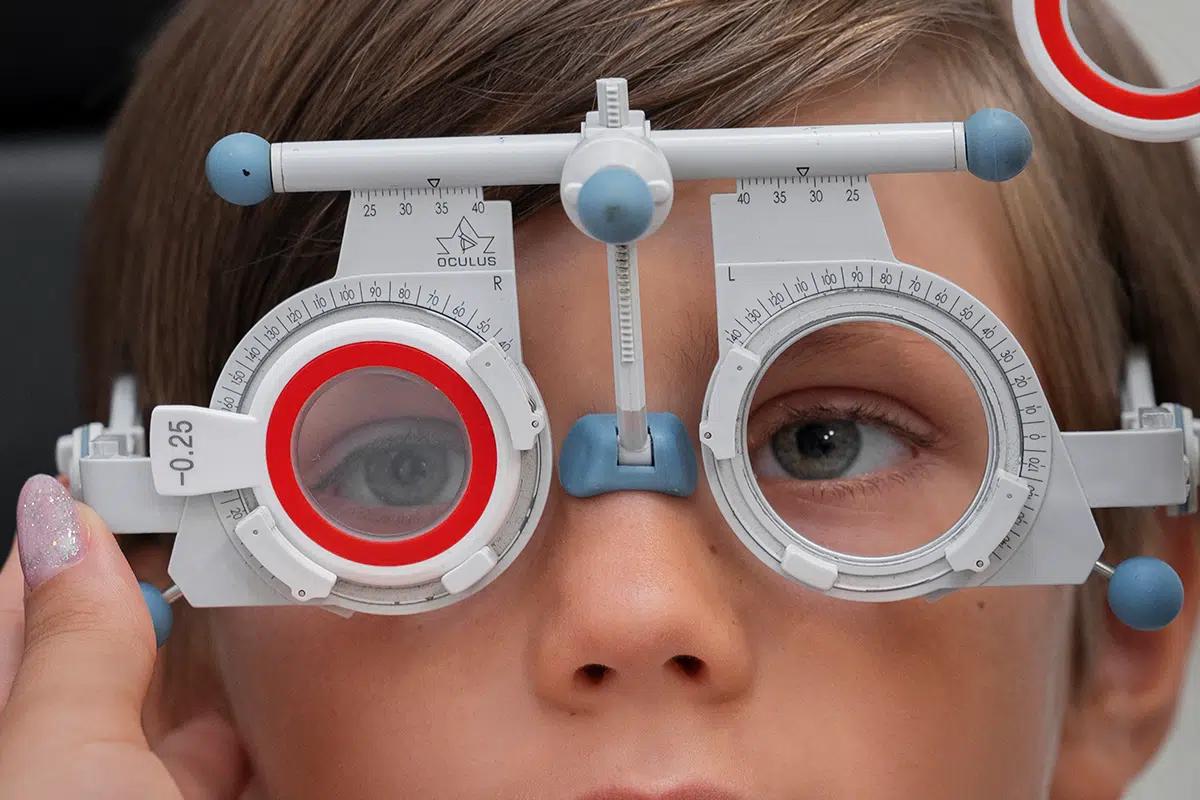
Refractive errors are the most common vision problems in childhood.
Early detection supports healthy visual development.
Refractive errors in children can be corrected safely.


What are refractive errors in children?
Refractive errors occur when light is not focused correctly on the retina, causing blurred vision. The most common in children are:
🔹 Myopia (short-sightedness): Difficulty seeing distant objects, which can affect performance at school and in outdoor activities.
🔹 Hyperopia (long-sightedness): Difficulty seeing close up, which can cause eye strain and problems with reading.
🔹 Astigmatism: Distorted vision both at distance and close up, which can lead to headaches and visual fatigue.
How can you tell if your child has a vision problem?
✅ They get too close to books, screens or the board.
✅ They squint or tilt their head to see better.
✅ They complain of headaches or eye strain.
✅ They have difficulty concentrating at school.
✅ They trip easily or seem poorly coordinated.
If you notice any of these symptoms, it is advisable to arrange an eye examination so that any vision problem can be detected and corrected in time.
Why do some children develop refractive errors?
Refractive errors in children can develop through a combination of genetic, environmental and eye-development factors. Some of the main reasons are:
1. Genetic factors 🧬
Children whose parents are short-sighted, long-sighted or have astigmatism are more likely to inherit these vision problems. Genetics influence the shape and length of the eye, which can affect how light is focused on the retina.
2. Growth and development of the eye 👶
A child's eye is still developing. In the first years of life it is normal for the eye to be shorter (physiological hyperopia). As the child grows, the length of the eye changes and, in some cases, development does not proceed optimally, resulting in myopia, hyperopia or astigmatism.
3. Environmental factors and visual habits 📱📚
Today's lifestyle can influence the onset of refractive errors, especially myopia. Factors such as:
✔ Too much time spent on screens and reading close up, which forces the eye's accommodation.
✔ Lack of exposure to natural light, which has been associated with the development of childhood myopia.
✔ Prolonged visual effort without breaks, which can accelerate the progression of some refractive errors.
4. Focusing and accommodation problems 🔍
Some children have difficulty focusing correctly on objects at different distances, which can lead to problems such as uncorrected hyperopia or astigmatism.
5. Associated eye conditions 👀
Some eye conditions, such as strabismus or amblyopia (lazy eye), may be related to refractive errors. Premature birth or congenital eye diseases can also play a part.
Solutions tailored to every visual need
The treatment of refractive errors in children depends on the type of visual error, its severity and the child's age. The right correction not only improves vision but also prevents problems with visual development and learning.
1. Glasses (spectacle lenses) 👓
Glasses are the most common and safest treatment for correcting myopia, hyperopia and astigmatism in children. They are essential to:
✔ Ensure clear vision and proper visual development.
✔ Prevent problems such as amblyopia (lazy eye) in cases of high or asymmetric prescriptions.
✔ Reduce eye strain and improve school performance.
2. Contact lenses 👁
In some cases, especially in older children, contact lenses may be an option when:
✔ There is a large difference in prescription between the two eyes (anisometropia).
✔ Optical correction is needed for sports.
✔ There are specific conditions, such as keratoconus.
3. Ortho-k therapy (orthokeratology) 🌙
These are rigid contact lenses worn overnight to temporarily reshape the cornea and correct myopia during the day. They may be an option for some children to control the progression of myopia.
4. Myopia control 🛑
In cases of progressive myopia, specific treatments can be used to slow its progression, such as:
✔ Low-dose atropine drops (under ophthalmological supervision).
✔ Special spectacle or contact lenses designed to slow the growth of the eye.
5. Refractive surgery ⚠
Laser surgery is not recommended in children, as their eyes are still developing.
Our Clinic
Unique spaces designed with one philosophy: excellence in caring for your eyes.




Detailed Diagnosis
A trusted environment where we listen to you, carry out a detailed diagnosis and design a personalised treatment plan together.




Commitment to Excellence
A team of professionals led by Drs. Ramírez and Gálvez with a dual commitment: medical excellence and close, human care.


Cutting-Edge Technology
Equipped with the latest technology to ensure diagnoses of maximum precision and to plan every treatment with complete safety.
Answers to your questions
We answer the most common questions about refractive errors in children. Here you will find all the information you need to look after your child's vision with confidence.
At what age can refractive errors be detected in children?
Vision problems can be detected from the first months of life. An eye examination is recommended at the age of 3 and before starting school.
Can refractive errors in children correct themselves?
In some cases, mild hyperopia may improve as the child grows, but myopia usually progresses with age.
Does screen use make refractive errors worse?
Excessive screen use can contribute to the development and progression of myopia, so it is advisable to limit it and encourage outdoor activities.
When are contact lenses advisable for children?
From the age of 8–10, if the child is responsible and needs vision correction without glasses, for example for sports or specific activities.
What happens if a refractive error is not corrected in childhood?
It can affect the child’s visual development, school performance and quality of life, as well as increasing the risk of lazy eye (amblyopia).
Can the onset of myopia in children be prevented?
Reducing screen use, spending more time outdoors and having regular eye examinations can help to reduce the risk of myopia and control its progression.