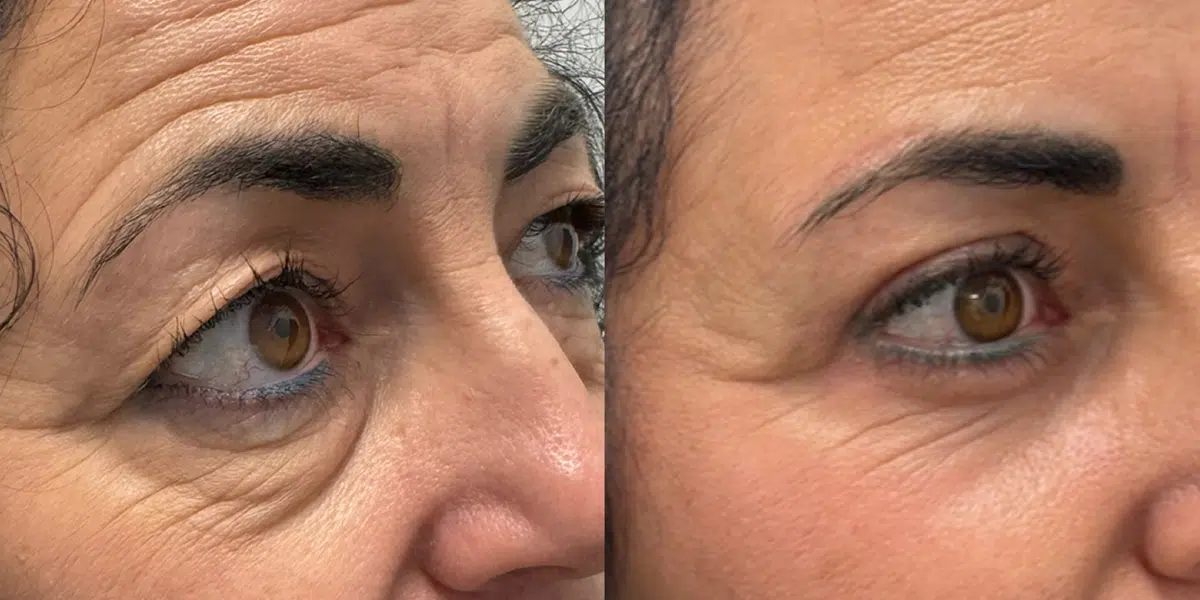
This is a surgical procedure designed to remove the excess skin and bags that build up on the eyelids. It not only improves appearance but can also relieve functional problems such as reduced vision.
The surgery is minimally invasive and recovery is fast.
It is a treatment that improves both the appearance and the function of the eye.
We aesthetically rejuvenate the eyes with natural results, without changing your facial expression.
What is Upper Eyelid Blepharoplasty?
Upper eyelid blepharoplasty is a precision procedure used to remove excess skin and fat, with the aim of achieving a more symmetrical eyelid contour.
However, in our view, blepharoplasty is not just about removing skin. It is essential to analyse every structural detail as a whole, including assessment of the lacrimal gland, the preaponeurotic fat and the ROOF fat. Addressing these elements is the key to achieving the most natural results possible and avoiding an "operated look".
✅ Aesthetic rejuvenation and functional improvement of vision.
✅ Natural results endorsed by our patients, without changing your expression.
✅ Correction of bags and removal of excess skin.
✅ Minimally invasive surgery with a fast recovery.
When should you consider this surgery?
Excess skin on the upper eyelids can cause a range of symptoms and discomfort that affect both appearance and function. The most common symptoms include:
🔹 Loss of peripheral vision: Excess skin can block the visual field, especially when looking up or to the sides.
🔹 A tired or aged look: Drooping eyelid skin gives an appearance of fatigue, even when you feel well.
🔹 Difficulty applying make-up: Excess skin can make it harder to apply cosmetics, affecting facial appearance.
🔹 Eye fatigue: Drooping skin can cause discomfort, as it rubs against the eyelashes or the area feels heavy.
If you experience any of these symptoms, blepharoplasty can be an effective solution.
Why does excess skin develop on the eyelids?
Ageing is the main cause of upper eyelid laxity, but other factors can contribute to it:
✅ Age: As we get older, the muscles and tissues of the eyelids weaken, causing the skin to droop.
✅ Genetics: Some people have a genetic predisposition to developing excess eyelid skin.
✅ Sun exposure: Prolonged exposure to the sun can accelerate skin ageing and contribute to laxity.
✅ Lack of sleep or stress: Constant fatigue and stress can show on the eyelids, worsening bags and wrinkles.
✅ Smoking: Smoking accelerates skin ageing and can contribute to laxity around the eyes.
Restore your eyes with safe and effective surgery
Upper blepharoplasty is a highly personalised procedure, designed to rejuvenate the eyes without altering your natural expression. As ophthalmologists specialising in oculoplastic surgery, we analyse multiple anatomical and functional factors in each patient to determine the most suitable technique. Beyond simply removing skin, today the surgery focuses on repositioning volume and harmonising the eyelid with the face.
Upper blepharoplasty is performed under local anaesthetic and, in many cases, with sedation. The procedure involves making a small incision in the natural crease of the eyelid, which allows excess skin and fat to be removed, leaving a scar that is practically invisible.
Types of Upper Blepharoplasty
Traditional blepharoplasty. Indicated when there is significant excess skin that creates a tired appearance or affects vision.
Upper blepharoplasty with CO2 laser. It offers the benefits of a more precise incision, less post-operative bruising and swelling, and a faster recovery.
Upper blepharoplasty with fat repositioning.
Instead of removing the fat, it is redistributed to avoid a hollow or aged look.
An ideal technique for maintaining a youthful, natural look.
Upper blepharoplasty combined with ptosis surgery (drooping eyelid due to muscle weakness).
It not only improves appearance but also optimises eyelid function.
Upper blepharoplasty combined with canthopexy or canthoplasty.
It is combined with tightening of the outer corner of the eye to improve the shape of the eyelid in cases of laxity.
It helps to avoid a sad or droopy look.
Most patients experience a fast recovery with little pain. Rest and avoiding exertion are recommended during the first few days, although most patients return to their normal activities within a week.
Before and after
Blepharoplasty: Upper and Lower Eyelids and Brow Lift
For comprehensive, harmonious aesthetic rejuvenation, a combined procedure was planned: a brow lift to raise the frame of the eyes, an upper blepharoplasty to open up the eyelid, and a lower blepharoplasty to correct the bags. The result is a visibly more open, fresh and rested expression, in complete harmony with the patient's natural features.
Before
After
Before and after
Blepharoplasty: Upper Eyelids and Brow Lift
To correct the feeling of "heavy eyelids" and rejuvenate the eyes, a high-precision procedure was performed that combined three techniques in one: an upper blepharoplasty to remove the excess skin, repositioning of the lacrimal gland, which had dropped, and a brow lift (browpexy). The result, just a month and a half later, is a visibly more open, brighter and more youthful look, with an even eyelid and a higher brow.
Before
After
Before and after
Blepharoplasty and Lacrimal Gland Repositioning
In this case, in addition to excess skin on the upper eyelid, the patient had a bulge in the outer area that became much more noticeable when she closed her eyes. This "bulge" was caused by dislocation (or herniation) of the lacrimal gland. For an optimal aesthetic result, an upper blepharoplasty was performed, combining removal of the excess skin with repositioning and anchoring of the gland in its correct position, thus treating the root of the problem.
Before
After
Before and after
Blepharoplasty: Upper and Lower Eyelids, Brow Lift and CO2 Laser
This case is the perfect example of comprehensive aesthetic rejuvenation of the eye area, in which all the signs of ageing have been treated for a harmonious result. The surgical plan combined a brow lift with a complete blepharoplasty (upper and lower) to reposition the tissues and remove excess skin and bags. As a complementary treatment, CO₂ laser resurfacing was performed to improve the quality and texture of the skin, achieving a complete yet always natural transformation.
Before
After
Before and after
Blepharoplasty: Upper Eyelids
The challenge with this young patient was to correct the "A-frame deformity" of the eyelid, which gave her a hollow, uneven appearance. A high-precision upper blepharoplasty was planned, removing a minimal amount of skin and focusing on volume repositioning to achieve an ideal eyelid contour. The result is a much more symmetrical, harmonious and aesthetically balanced look that fully respects her natural appearance.
Before
After
Before and after
Blepharoplasty: Transconjunctival
To rejuvenate this patient's eyes, a two-fold plan was designed. First, the fat bags were removed through a transconjunctival blepharoplasty (from the inside, with no scar on the skin). Second, lateral skin tightening was performed to firm up the eyelid skin. This combination of techniques allows us to achieve a firmer, more rested and natural look, always respecting the original expression.
Before
After
Our Clinic
Unique spaces designed with one philosophy: excellence in caring for your eyes.
Detailed Diagnosis
A trusted environment where we listen to you, carry out a detailed diagnosis and design a personalised treatment plan together.
Commitment to Excellence
A team of professionals led by Drs. Ramírez and Gálvez with a dual commitment: medical excellence and close, human care.
Cutting-Edge Technology
Equipped with the latest technology to ensure diagnoses of maximum precision and to plan every treatment with complete safety.
Answers to your questions
We answer the most common questions about the symptoms and treatment of excess skin on the upper eyelids. Find all the information you need here to make your decision with complete confidence.
The surgery is performed under local anaesthetic, so you will not feel any pain during the procedure. After surgery you may experience some discomfort, which is controlled with painkillers.
Yes, the results of upper eyelid blepharoplasty are long-lasting, although the ageing process will continue and new signs of laxity may appear over time.