


Search
What are you looking for?
Find treatments, eye conditions and blog articles.
Technology at the serviceof your eyesight
We work with up-to-date diagnostic and treatment equipment so we can study each eye in detail and suggest the option that best suits each person. Technology is a tool: the decision is always made together with your ophthalmologist.

How we choose
our technology
Diagnosis first
Good technology starts with studying each eye properly. That is why we give so much importance to preliminary tests.
At the service of medical judgement
Equipment helps, but the indication is decided at the consultation, together with your ophthalmologist.
Safety and comfort
Whenever possible we prefer quick, non-contact tests and techniques that care for the tissue.
Continuous updating
We review our equipment and keep training continuously to offer up-to-date options.
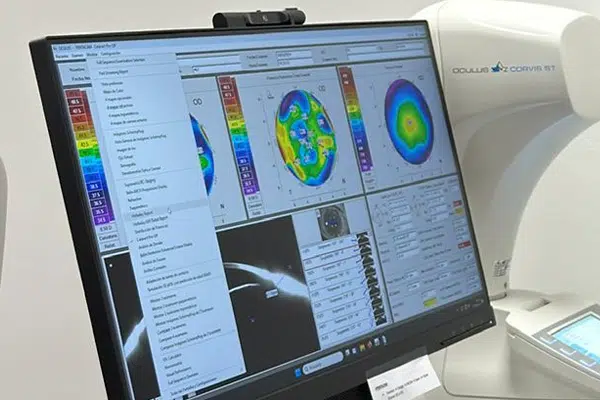
Corneal topography and tomography
Detailed maps of the surface and thickness of the cornea.
Corneal topography and tomography measure the shape, curvature and thickness of the cornea in great detail. They are quick, painless tests that we use to assess whether someone is a candidate for refractive surgery, detect irregularities and plan treatment with more information.
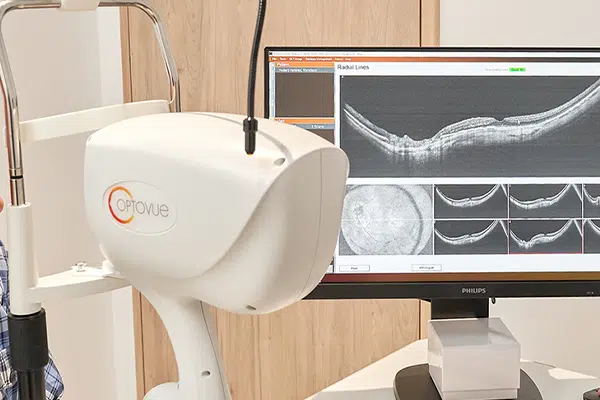
Optical coherence tomography (OCT)
High-resolution cross-sections of the retina and optic nerve.
OCT lets us see the layers of the retina and optic nerve without contact and in a few minutes. It is a key tool for diagnosing and monitoring conditions such as glaucoma, macular degeneration or diabetic retinopathy, and it helps decide when and how to treat.
Femtosecond laser
Precision and personalisation to correct myopia, hyperopia and astigmatism.
With the Femtolasik technique, the femtosecond laser creates the corneal flap without a blade, with a precise and uniform cut, and planning is personalised using the corneal tests. The most suitable technique (Femtolasik, LASIK, PRK or others) is decided at the consultation according to the characteristics of each eye.

Phacoemulsification and intraocular lenses
A small-incision technique to restore the clarity of the lens.
Phacoemulsification uses ultrasound to break up and remove the cloudy lens, and an intraocular lens chosen according to each person’s visual needs is implanted. It is usually done as day surgery, without a hospital stay.

CO₂ laser
One technology for eyelid surgery and aesthetic medicine around the eyes.
The CO₂ laser cuts precisely while instantly sealing small blood vessels, which is used in laser blepharoplasty. In fractional mode it is used for resurfacing: micro-beams of light that stimulate skin regeneration to improve fine lines and texture. Each treatment is indicated after an individual assessment.
Other techniques
we use
Intense pulsed light (IPL)
Used both in aesthetic care around the eyes (spots, redness) and in the treatment of dry eye caused by meibomian gland dysfunction. Learn more
Platelet-rich plasma (PRP)
Obtained from the person’s own blood and used in rejuvenation treatments of the eye area. Learn more
Radiofrequency
Used as a complement to other aesthetic treatments around the eyes, depending on each case.