


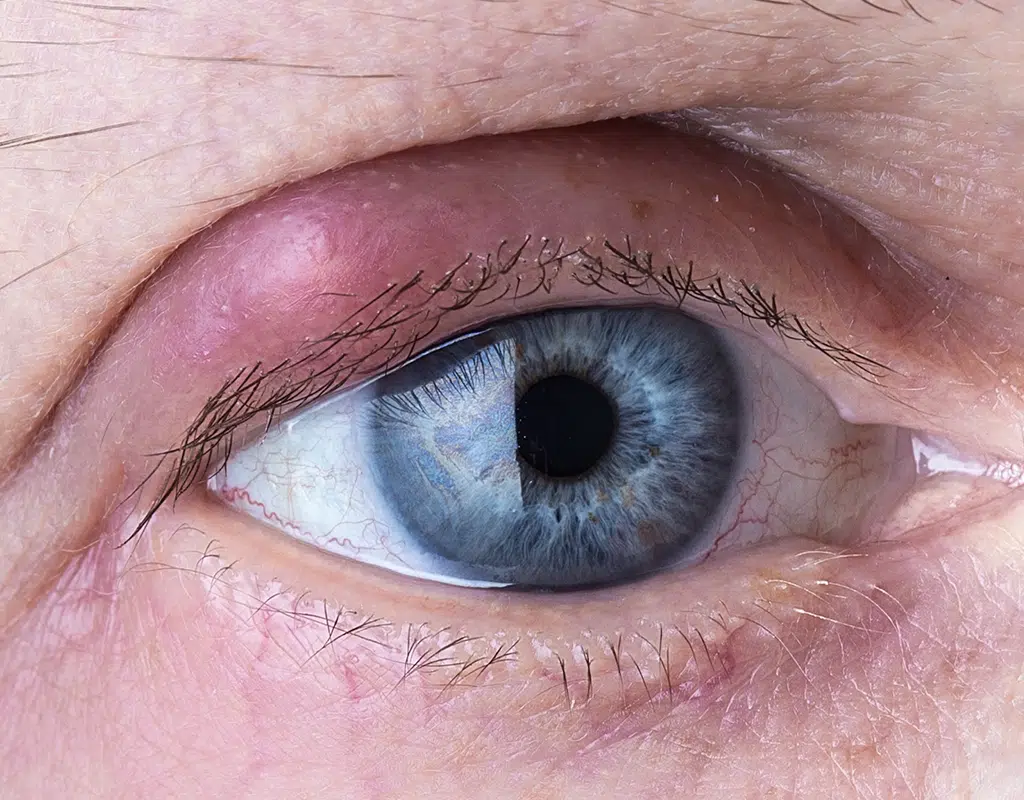
You wake up, look in the mirror and see a little red bump on your eyelid. And the usual question comes up: is it a stye or a chalazion? They look very alike and get mixed up every day, but they are not the same, they are not treated the same way and, above all, they do not evolve the same way. Knowing how to tell them apart saves you weeks of worry (and more than one home remedy that makes things worse).
At Clínica Ramírez & Gálvez we see these little eyelid lumps every week. We explain clearly what each one is, how to tell them apart, what you can do at home, what you should never do and when it is time to have an ophthalmologist look at it.
Stye: a small acute infection 🔥
A stye (hordeolum) is an infection of a gland at the edge of the eyelid, almost always caused by the bacterium Staphylococcus aureus. It is like a “pimple” on the eyelid: it appears quickly, within a day or two, and it hurts.
- Pain and tenderness from the very beginning.
- Localised redness and swelling, often next to the eyelashes.
- A yellowish spot (like the head of a pimple) that may end up draining on its own.
- Watering, stinging and a foreign-body sensation in the affected eye.
If the infection is at the edge of the eyelid, it is called an external stye; if it affects a deeper gland (the meibomian glands), we speak of an internal stye, which usually hurts more and is harder to see.
Chalazion: a hard lump that doesn’t hurt 🧐
A chalazion arises differently. One of the meibomian glands, which produce the oil that protects your tear film, becomes blocked. The oil gets trapped, the surrounding tissue reacts with chronic inflammation and a nodule forms. It is not an infection, although it can start as one.
- A firm, rounded lump inside the eyelid, like a small “ball” under the skin.
- It usually doesn’t hurt, or only bothers you at the start.
- It grows slowly, over days or weeks, and can last for months if left untreated.
- Temporary blurred vision if it is large, because it presses on the cornea and slightly changes its curvature.
Stye vs. chalazion: the differences at a glance 📋
| Stye | Chalazion | |
|---|---|---|
| What it is | Acute infection of an eyelid gland | Chronic inflammation from a blocked meibomian gland |
| Pain | Yes, from the start | Little or none |
| Appearance | Red, warm, with a yellowish spot | Hard nodule, skin-coloured or slightly pink |
| Onset | Within 1–2 days | Gradual, over days or weeks |
| Usual duration | 1–2 weeks | Weeks to months |
| Clears up on its own | Almost always | Sometimes, but it can become chronic |
An important detail: a stye that isn’t fully resolved can leave a chalazion. That is why many people say “my stye hasn’t gone away” when, in reality, what remains is a chalazion.
What to do at home (and what not to) 🏠
What helps
- Local heat: apply a clean, warm (never hot) compress over the closed eyelid for 10 minutes, 3 or 4 times a day. Heat softens the oil and helps the gland drain.
- Gentle massage: after the heat, a very delicate massage over the eyelid, towards the lash line, can help empty the gland.
- Eyelid hygiene: clean the edge of your eyelids once a day with wipes or foam made for eyelids.
- Patience: a stye usually improves in one to two weeks. A chalazion needs longer.
What to avoid
- Squeezing or popping the lump. You can spread the infection to neighbouring tissue and leave a scar.
- Wearing make-up or contact lenses while the problem lasts.
- Using home remedies (herbal infusions, tea bags, garlic, etc.). They are not sterile and can irritate or infect the eye.
- Self-medicating with antibiotic eye drops or ointments without a doctor’s advice.
When to see an ophthalmologist 🚨
See an ophthalmologist if you are in any of these situations:
- The lump hasn’t improved after 3–4 weeks of heat and hygiene.
- You have severe pain or the eyelid swells a lot, turns very red or you develop a fever. It could be an infection that is spreading and needs prompt treatment.
- Your vision gets worse or the lump is large and presses on the eye.
- It always appears in the same spot. A lump that keeps coming back in the same place or causes eyelash loss should always be checked, because in rare cases it can hide another type of lesion.
- It affects a young child or a person with diabetes or a weakened immune system.
- Episodes are frequent: they are often linked to blepharitis, dry eye, rosacea or insufficient eyelid hygiene.
Treating a persistent chalazion 🔬
When a chalazion doesn’t go away with conservative measures, there are simple solutions. After assessing it in consultation, the ophthalmologist may suggest:
- Medical treatment: heat routines, eyelid hygiene and, in some cases, topical anti-inflammatories.
- Injection: a small injection into the nodule to reduce inflammation in suitable cases.
- Minor in-office surgery: under local anaesthesia, a minimal incision is made, through the inner surface of the eyelid when possible, to empty the contents of the gland. It is a short procedure and recovery is usually quick.
In addition, treating the underlying cause (blepharitis, meibomian gland dysfunction, dry eye) is what really prevents it from coming back. If you are interested, you can see all the eye surgery options we offer at our clinics.
Frequently asked questions about styes and chalazion ❓
Is a stye contagious?
Not usually. Even so, don’t share towels or make-up, and wash your hands before and after touching your eyelid.
Can a chalazion go away on its own?
Yes, in some cases it is reabsorbed with heat and patience within a few weeks. If it persists, it should be checked to prevent it from growing or becoming chronic.
Will I be left with a scar?
With proper management, normally not. That is why it is important not to squeeze the lump and to have it checked if it doesn’t improve.
How can I prevent it from coming back?
With daily eyelid hygiene, removing make-up thoroughly at night, treating dry eye or blepharitis if you have them, and avoiding rubbing your eyes with dirty hands.
Do you have a little lump on your eyelid that won’t go away or keeps coming back?
Don’t let it slide: Book your check-up at our clinics in Lucena or Torre del Mar and get your eyelids comfortable again. 📅✨


