A small yellowish patch next to the inner corner of your eye that doesn’t hurt, doesn’t itch and doesn’t bother you… but that is there every time you look in the mirror, and seems to grow over time. If that sounds familiar, it is very likely a xanthelasma. They are very common, benign and treatable, although there is one thing worth knowing: sometimes they are more than a cosmetic matter.
At Ramírez & Gálvez Clinic we explain what xanthelasma is, how it relates to cholesterol, how to tell it apart from other eyelid lesions and what the options for removing it are.
What is xanthelasma? 🟡
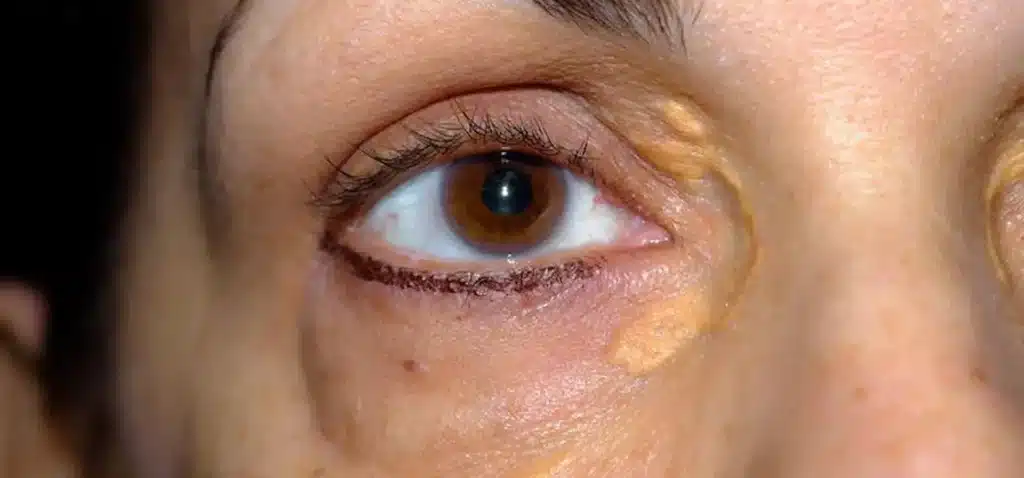
Xanthelasmas are fat (cholesterol) deposits under the skin of the eyelids. They look like yellowish or whitish patches with a smooth or slightly raised surface, appearing mostly on the inner part of the eyelid, near the tear duct, and more often on the upper lids. They can appear in one or both eyes and, although they are soft and painless, they tend to grow or multiply over time.
They are more common after the age of 40. They do not affect vision and are not dangerous in themselves, but they can be unsightly, because they give the eyes a tired look.
What do they say about your cholesterol? 🩸
This is the big question. The answer is nuanced:
- They can point to high cholesterol or triglycerides. In a significant share of people with xanthelasma, blood lipids are altered.
- But they also appear with normal lipids. According to studies, around half of people with xanthelasma have normal cholesterol; family predisposition and other factors play a part.
- They can be associated with other metabolic conditions, such as diabetes or some liver problems.
- Some studies link them to a higher cardiovascular risk. So even if the eyelid is the reason you came in, it is a good idea to check your general health.
What to do: if you develop a xanthelasma, ask for a blood test with a lipid profile (cholesterol and triglycerides) and discuss the result with your GP. This is especially important if they appear before the age of 40 or if there is a family history of high cholesterol or early heart attacks.
How to tell them apart from other eyelid lesions 🔍
Not every lump or mark on the eyelid is a xanthelasma. These are the most common mix-ups:
A chalazion or a stye are inflammatory lumps; a milium is a tiny cyst; and there are other lesions, including some eyelid tumours, that need an accurate diagnosis. So for any new lesion, or one that changes, it is best to have an ophthalmologist look at it.
Do they go away on their own? What about creams or home remedies? ❌
No. They are fat deposits in the skin and do not disappear without treatment. Creams, oils and home remedies do not remove them and can irritate skin as delicate as the eyelid. It is also not a good idea to try to remove them yourself, or to prick or scratch the lesion: the area is very sensitive and you could leave a scar.
How xanthelasma is removed 🔬
There are several techniques: laser, surgical excision, acid peels or electrocoagulation. The choice depends on the size, depth and location of the lesion. Among them, the CO2 laser is the most precise option with the best recovery: it vaporises the deposit layer by layer, respecting the surrounding skin.
The procedure is done under local anaesthetic, is quick and you feel no pain during it. If you would like to know more about this technology, you will find all the information on our CO2 laser resurfacing page and in this article on why CO2 laser needs planning.
Recovery and aftercare ☀️
- Scabbing and redness: it is normal for thin scabs to form for around 5–10 days; afterwards the skin is pink and gradually evens out over the following weeks.
- Don’t pick the scabs: let them fall off on their own.
- Strict sun protection: high-factor sunscreen and sunglasses, to avoid marks on the treated area.
- Follow the healing instructions and attend the follow-up visits we recommend.
Can they come back? 🔁
Treatment removes the xanthelasma you have, but it does not change your cholesterol or your predisposition on its own. New ones can appear, especially if your lipids remain altered. That is why it is worth looking after your metabolic health: a balanced diet, exercise and the check-ups your doctor recommends.
When to see an expert ⚠️
- You have a new patch or lump on your eyelid and don’t know what it is.
- The lesion grows, changes colour, bleeds or makes you lose eyelashes.
- They appeared before the age of 40 or you have a family history of high cholesterol.
- You want to have them removed for cosmetic reasons.
Frequently asked questions about xanthelasma ❓
Are they dangerous?
Not in themselves: they are benign and do not affect vision. What matters is checking your cholesterol and general health, because they are sometimes associated with metabolic changes.
Does the treatment hurt?
It is done under local anaesthetic, so you feel no pain during the procedure. Afterwards there may be mild stinging or tightness for a few days.
Is laser removal permanent?
The laser removes the xanthelasma completely, although new ones can appear in other areas if cholesterol problems or the predisposition persist.
Are they hereditary?
There can be a family predisposition, especially when high cholesterol has a genetic origin. If there is a history in your family, it is worth discussing it with your doctor.
Does make-up help?
Concealer can disguise them, but it does not remove them or stop them growing. Also, make-up around the eyelid requires good hygiene so as not to irritate the eye.
Do you have a yellow patch on your eyelid and want to know what it is and how to remove it?
Find out with an assessment: Book your appointment at our clinics in Lucena or Torre del Mar and get back a rested look. 📅✨